
Table of Contents
- Why Upgrading Your Gear in 2026 Makes Sense
- Pickleball Paddle Technology Explained: What Actually Matters
- Top-Rated Pickleball Paddles for 2026: Our Picks
- How to Choose Golf Clubs for Performance: A Practical Guide
- Best Golf Club Sets for Intermediate Players in 2026
- Cross-Sport Performance: Training Tips for Both Games
- Durability and Injury Prevention: Making Your Gear Last
- Conclusion: Your 2026 Performance Upgrade Starts Here
- Frequently Asked Questions
Last Updated: September 21, 2026
Why Upgrading Your Gear in 2026 Makes Sense
The gap between a casual player and a competitive one often comes down to equipment, not talent. At The Pickle and The Pro, we built our store around two sports instead of one.
Most players wait too long to upgrade. They blame their swing, their footwork, their age. Then they borrow a friend's paddle or test a different ball and everything changes.
The right gear doesn't make you a better athlete. It removes the friction that was hiding how good you already are.
This guide covers top-rated pickleball paddles and golf clubs for 2026, with a focus on what actually moves your performance forward.
Pickleball Paddle Technology Explained: What Actually Matters
Pickleball paddle technology explained comes down to three measurable performance metrics: power, spin, and control. Every spec sheet you read maps back to one of those three.

Paddle core thickness drives the feel. A thicker core, like 16mm, gives you more dwell time and a softer touch for dinking and resets. A thinner 13mm or 14mm core produces more pop and a faster launch angle off the face.
Surface texture determines spin rate. Raw carbon fiber faces grab the ball and let you shape shots, while smoother surfaces trade spin for durability.
Swing weight and twist weight decide how the paddle feels in your hand. Higher twist weight means more torsional stability on off-center hits. Lower swing weight means better maneuverability at the net.
Thermoformed construction, where the core and face are bonded under heat and pressure, tends to produce a more consistent sweet spot and better shot consistency over time.
Top-Rated Pickleball Paddles for 2026: Our Picks
The best pickleball paddles for 2026 balance power, spin, and control against your actual playing style. Here are three we recommend, each suited to a different type of player, plus the testing framework we use to rank them.
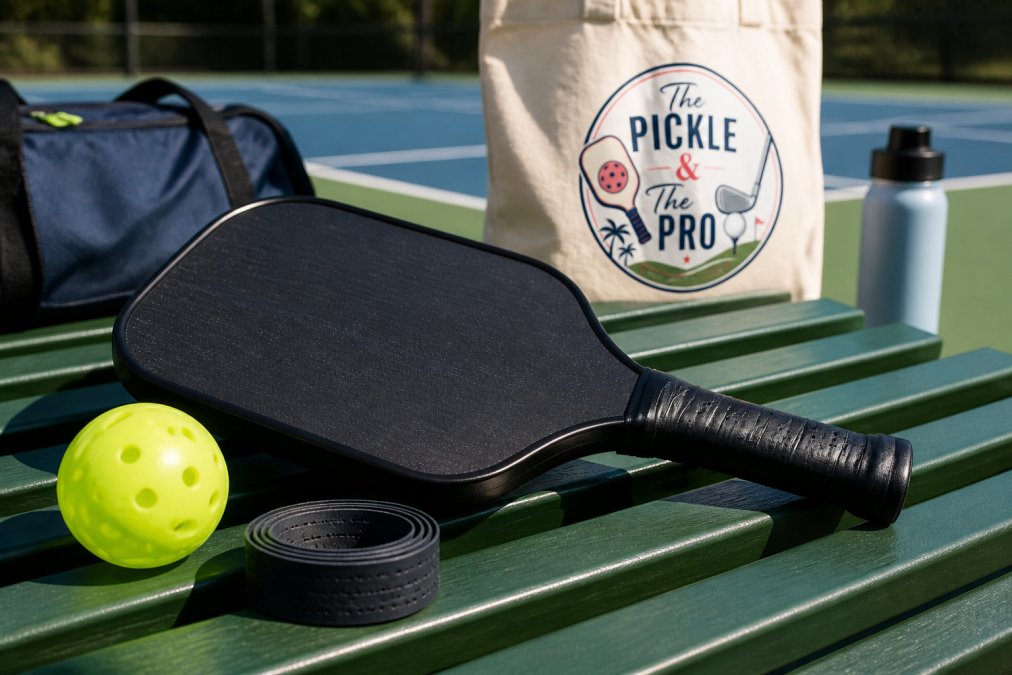
How we test and rank paddles
Every paddle we recommend goes through the same protocol before it earns a spot here:
- Baseline spec verification, we weigh each paddle on a digital scale, measure grip circumference with calipers, and confirm core thickness against the manufacturer's claim.
- Spin testing, we hit a set number of serves and drives with a marked ball to estimate RPM, then compare against the manufacturer's lab figure.
- Off-center strike testing, we deliberately hit 2 inches off the sweet spot to gauge twist weight and torsional stability.
- Durability cycling, we track how the face texture and core feel change over 40+ hours of play, because out-of-the-box performance tells you nothing about month six.
The picks at a glance
| Paddle | Price | Core | Best For |
|---|---|---|---|
| FLiK F3 All-Court | $190.00 | 16mm triple core | Balanced control |
| Phoenix 16MM | $219.99 | 16mm honeycomb | Power players |
| REV ARIA PRO | $99.99 | 14mm honeycomb | Value upgrade |
FLiK F3 All-Court Paddle: Best for Balanced Control
The FLiK F3 is a USA Pickleball-approved all-court paddle built for intermediate and advanced players who want balanced court coverage. Its 16mm triple core uses double floating EPP foam cores inside a low-density EVA foam perimeter ring, which expands the active sweet spot.

The face is three layers of premium T700 raw Toray carbon fiber, generating a 2100+ RPM spin rate. A solid PU handle keeps vibration dampening steady.
Choose from three shapes: Elongated (16.5" x 7.5"), Hybrid (16.3" x 7.7"), or Standard (16" x 8"). All share a 5.5-inch handle length, 4.15-inch grip circumference, and 8.0-ounce static weight.
Where it falls short: At $190, it costs more than a beginner paddle, and the triple-core build rewards players who already have consistent mechanics.
Phoenix Pickleball Paddle: Best for Power Players
The Phoenix is UPA-A approved and built for modern competition. Its elongated shape and power-focused balance help you accelerate drives and finish points.
The PowerDrive System combines 2cm TPE foam, a dense honeycomb core, and an EFC edge wall for quick energy transfer. The Endura Spin face, three layers of raw T700 carbon fiber, is lab-tested to 2100+ RPM.
A 5.6" octagonal handle and EVA cushioning reduce arm fatigue during long matches.
The drawback: The firm feel and head-heavy balance punish late contact. This is a paddle for players who already generate their own pace.
REV ARIA PRO: Best Value Upgrade
The REV ARIA PRO is the strongest price-to-performance pick here. At $99.99, it uses thermoformed unibody construction, a T700 raw carbon fiber face, and foam-injected walls.
The 14mm honeycomb core delivers a quicker, more responsive feel than thicker cores, which suits fast exchanges at the net. The elongated shape and 5.5-inch handle support two-handed backhands.
It's USAPA Approved and weighs about 8.0 oz.
The trade-off: A 14mm core offers less dwell time than a 16mm paddle, so soft-game touch takes more practice.
Intermediate vs. advanced: which pick fits you
- Intermediate players (3.0-3.5 DUPR), start with the FLiK F3 or REV ARIA PRO. The 16mm core on the F3 forgives inconsistent contact; the 14mm REV rewards players who already have fast hands.
- Advanced players (4.0+ DUPR), the Phoenix's head-heavy balance and firm face suit players who generate their own power and want maximum drive speed.
Durability and injury prevention
- Vibration dampening matters for joint health. The FLiK Falcon uses five circular cork dwell pads around the sweet spot to dampen vibration, which helps with wrist relief and tennis elbow mitigation. If you're upgrading specifically to reduce arm strain, prioritize a paddle with a PU or EVA handle wrap and a foam-injected perimeter.
How to Choose Golf Clubs for Performance: A Practical Guide
Learning how to choose golf clubs for performance starts with your ball flight, not the brand name. Before you buy, track three things: your typical miss, your average carry distance, and your spin rate.
A launch monitor makes this objective. The Garmin Approach R10 tracks club head speed, ball speed, spin, launch angle, and smash factor, and records video clips with stats overlaid on each swing.
Ball choice matters as much as the club.
Best Golf Club Sets for Intermediate Players in 2026
The best golf club sets for intermediate players prioritize forgiveness over workability.
What to check before you buy
Shaft flex. Regular flex fits most male golfers with driver swing speeds in the 85-95 mph range; senior or lightweight flex fits below that; stiff fits above. A launch monitor session tells you which band you're in.
Pairing clubs with the right ball
Ball choice matters as much as the club. A low-compression ball like the TaylorMade SpeedSoft promotes faster ball speeds for moderate swing speeds. A four-piece urethane ball like the Wilson Staff Model adds stopping power on wedge shots. The Mizuno Pro S uses a soft urethane cover for spin control around the greens.
Practice tools that change how fast you improve
For serious practice, a launch monitor changes how fast you improve. The Garmin Approach R10 offers portable tracking with more than a dozen metrics and a library of 43,000+ virtual courses. At the top end, the Foresight QuadMAX uses four-camera photometric technology and includes clubhead measurement, putting analysis, and 25 courses.
The cross-sport upgrade angle
If you also play pickleball, your golf swing and your pickleball drive share the same rotational power source. Fix the swing fault once and both sports improve, which is why we recommend testing a club upgrade and a paddle upgrade in the same season, not separately.
Cross-Sport Performance: Training Tips for Both Games
Golf and pickleball share more athletic DNA than most players realize. Both reward rotational power, a stable base, and consistent hand-eye timing.
The cross-sport edge comes from training the overlap:
- Rotational core work builds swing and drive power in both sports
- Grip strength and forearm conditioning reduce fatigue in long rounds and matches
- Balance drills improve weight transfer on the course and split-step timing on the court
Durability and Injury Prevention: Making Your Gear Last
Durability and injury prevention come down to maintenance habits and equipment choices.
Conclusion: Your 2026 Performance Upgrade Starts Here
The hardest part of upgrading isn't choosing the gear. It's committing to one change and measuring whether it actually helped.
Frequently Asked Questions
What are the top-rated pickleball paddles for 2026?
The top-rated pickleball paddles for 2026 include the FLiK F3 All-Court for balanced control, the Phoenix 16MM for power players, and the REV ARIA PRO for value. Each offers T700 carbon fiber faces and USA Pickleball approval. The best choice depends on your play style: control, power, or a mix. Test a few if possible.
How do I choose the right golf clubs for my skill level?
Start with game-improvement irons if you're intermediate, as they offer forgiveness on off-center hits. Consider clubhead speed and launch angle. A launch monitor like the Garmin Approach R10 can measure your swing metrics to guide loft and shaft flex decisions.
Is it worth upgrading my pickleball paddle and golf clubs in 2026?
Yes, if your current gear is over three years old or you've outgrown its performance. Newer paddles like the FLiK Falcon feature enhanced shock absorption for joint health, while modern golf balls like TaylorMade SpeedSoft offer low-compression cores for faster ball speeds. Upgrading can improve consistency and reduce fatigue.
What is the newest technology in pickleball paddles for 2026?
The newest pickleball paddle technology in 2026 includes thermoformed unibody construction, foam-injected walls, and triple-core architectures that expand the sweet spot. Paddles like the FLiK F3 use double floating EPP foam cores, while the Phoenix integrates TPE foam for power and stability. These features enhance spin, control, and vibration dampening.