
Table of Contents
- Pickleball vs Golf: A Side-by-Side Comparison
- Cost of Entry and Equipment Investment
- Time Commitment, Court Time, and Tee Time
- Physical Intensity, Injury Prevention, and Sport Longevity
- Social Dynamics: Clubhouse Culture vs Kitchen Culture
- Cross-Sport Athletic Training: How Golf and Pickleball Complement Each Other
- Best Gear for Multi-Sport Athletes: What to Look For
- Frequently Asked Questions
Last Updated: September 27, 2026
Pickleball vs Golf: A Side-by-Side Comparison
Pickleball vs golf is no longer an either-or decision for active adults. At The Pickle and The Pro, we talk to players every week who want both: the fast-twitch energy of the kitchen and the slow rhythm of the tee box. The two sports sit at opposite ends of the intensity spectrum, which is exactly why they pair so well. One delivers a quick aerobic hit in under an hour. The other rewards patience across a four-hour round. Below, we break down cost, time, physical demand, social culture, and how each sport actually makes the other better.
Cost of Entry and Equipment Investment
Golf costs more to start. A beginner can walk onto a pickleball court with a paddle and court shoes, while golf requires clubs, balls, a bag, and greens fees before the first swing.
The gap narrows over time. Pickleball players upgrade paddles as their game sharpens, and a serious paddle now competes with mid-range golf gear on price. Building a single bag that serves both sports is where multi-sport athletes save the most.
| Category | Pickleball | Golf | Notes |
|---|---|---|---|
| Starter gear | Paddle + court shoes | Clubs + bag + balls | Golf has more pieces |
| Upgrade path | Paddle, then paddle again | Irons, woods, wedges | Both reward patience |
| Ongoing cost | Court fees, balls | Greens fees, balls, tees | Golf runs higher per session |
| Best-for | Quick sessions, new players | Full-day rounds, tradition | Depends on your week |
Our ARTI 14mm T700 Carbon Fiber paddle sits at $118.99 and carries USA Pickleball approval, making it a sensible first serious paddle. On the golf side, the Wilson Staff Model Golf Balls 2024 at $49.99 give you a four-piece urethane ball with a medium-compression core for flatter ball flight.

Time Commitment, Court Time, and Tee Time
Court time is the biggest practical difference, but the real story is how each sport fits into a week. A pickleball match runs 20 to 40 minutes, and most facilities let you rotate in and out for a couple of hours. Tee time is a four-to-five-hour block once you count travel, warm-up, and the round itself. That asymmetry matters for anyone with a job and a family. Pickleball fits into a lunch break. Golf needs a cleared calendar.
The scheduling mechanics go deeper than duration. Pickleball is drop-in friendly: you show up, you get slotted into a rotation, and you leave when you want. Golf is reservation-driven: you book a tee time, you commit to a group, and you finish when the group finishes. That difference shapes which sport you reach for on a chaotic day versus a planned one.
Seasonality flips the equation in much of the country. Pickleball is largely weather-independent when played indoors, which means it holds a steady weekly slot year-round. Golf is seasonal in most markets, so players compress their rounds into the warmer months and look for a winter alternative. That's where the pairing pays off: pickleball becomes the off-season anchor, and golf becomes the warm-weather reward.
A common pattern among multi-sport players is to treat pickleball as the weekday sport and golf as the weekend anchor. You keep your aerobic base up during the week and still get the long, focused round on Saturday. The learning curve for pickleball is measured in weeks. Golf's swing mechanics take seasons to settle.
The mental-health angle is where this pairing gets interesting. Pickleball's short, high-intensity bursts trigger the kind of quick stress relief that comes from fast movement and social laughter. Golf's long, low-intensity duration produces a different effect: a slow unwinding that most players describe as meditative. One resets you in an hour. The other resets you in an afternoon. Players who use both report that the short format keeps them from skipping exercise on busy days, while the long format gives them the deep decompression that a 30-minute session can't deliver.
Physical Intensity, Injury Prevention, and Sport Longevity
Pickleball is the higher-intensity sport by a wide margin. You'll do lateral shuffles, quick direction changes, and repeated overheads. Golf loads the lower back and shoulders through rotation and a repetitive swing.
Both carry injury risk, and the risks are different. Pickleball punishes players who skip warm-ups and lunge for balls they should let go. Golf punishes players who swing cold and ignore core strength. Neither sport is inherently dangerous, but each rewards preparation.
Sport longevity favors golf slightly, since you can play it into your eighties with a cart and a shorter swing. Pickleball's physical intensity is manageable, but the stop-start demand adds up. Players who protect their knees and shoulders early tend to stay on court longer.
What's the best way to avoid injury in both sports?
Warm up for ten minutes before either sport, focusing on hip rotation, shoulder mobility, and light lateral movement. Add two strength sessions a week for your core and legs. That single habit covers most of what both sports demand.
Social Dynamics: Clubhouse Culture vs Kitchen Culture
Clubhouse culture is structured. Golf pairs you with a group for four hours, and conversation builds slowly between shots. Executive networking happens naturally because you're walking the same fairway with the same people for most of an afternoon. The social contract is clear: you show up with a group, you stay with that group, and the relationship deepens through shared quiet. That format rewards patience and produces the kind of professional connection that's hard to manufacture in a conference room.
Kitchen culture is the opposite. Pickleball's social interaction is loud, fast, and constant. You rotate partners, you dink with strangers, and you're laughing within ten minutes of arriving. The barrier to entry socially is close to zero.
Cross-Sport Athletic Training: How Golf and Pickleball Complement Each Other
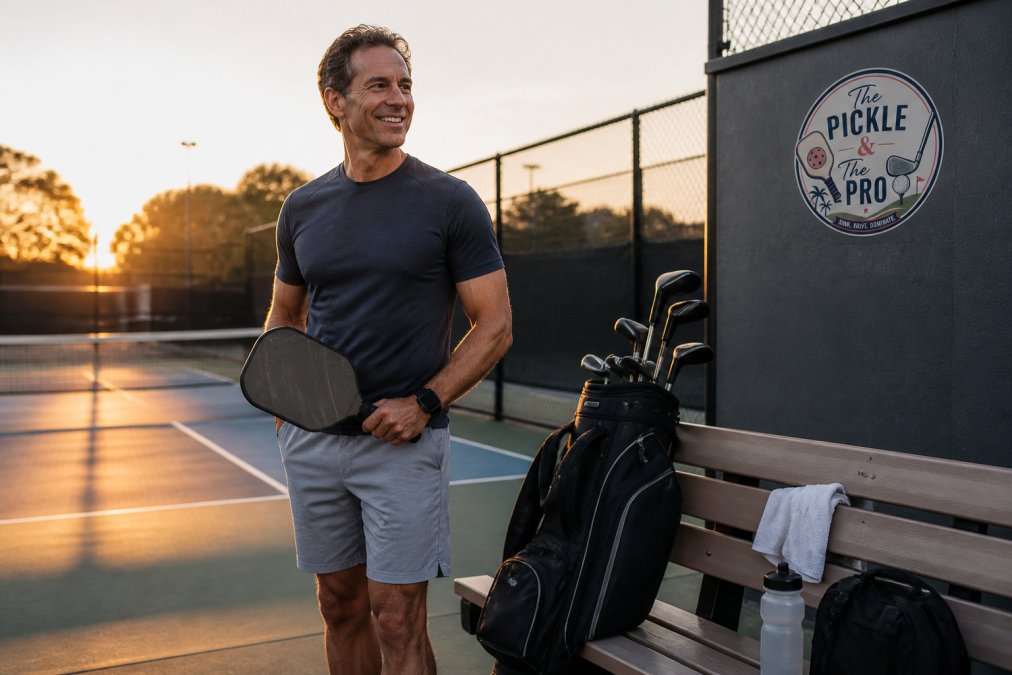
Cross-sport athletic training is the practice of building one fitness base that serves two different movement patterns. Golf and pickleball are unusually compatible here because they train opposite ends of the same system.
Best Gear for Multi-Sport Athletes: What to Look For
The best gear for multi-sport athletes is gear that earns its place in two bags. You want equipment that holds up, travels well, and doesn't force you to choose one sport over the other.
Three things matter most:
- Durability over novelty. Carbon fiber faces and urethane covers last longer than budget alternatives.
- Weight and portability. A 14-way stand bag and a paddle with a cover both need to move easily.
- One purchase, two uses. Court shoes work on the range. A good stand bag works whether you walk or ride.
| Gear | Price | Best For | Why It Works for Both |
|---|---|---|---|
| FLiK F3 All-Court Paddle | $190.00 | Balanced control | Three shapes, one weight |
| Phoenix Pickleball Paddle - 16MM | $219.99 | Power players | Stable on off-center hits |
| ARTI 14mm T700 Carbon Fiber Paddle | $118.99 | First serious paddle | USA Pickleball approved |
| Sun Mountain Eclipse E-3.5 Stand Bag | $240.00 | Organized golfers | 14-way top, electric-ready |
| Wilson Staff Model Golf Balls 2024 | $49.99 | Tour-level feel | Four-piece urethane |
USA Pickleball equipment standards and approved paddle list

Frequently Asked Questions
How do golf and pickleball complement each other in an active lifestyle?
Golf builds patience, rotational power, and hand-eye coordination over a long, low-intensity round. Pickleball delivers quick bursts of aerobic exercise, fast reflexes, and constant social interaction in a much shorter window. Players who do both get variety: a slow, strategic outdoor day and a fast, high-energy court session. The mix keeps training interesting and reduces the repetitive strain that comes from playing only one sport year-round.
What gear is essential for transitioning between golf and pickleball?
For pickleball, a USA Pickleball-approved paddle with a forgiving sweet spot makes the learning curve easier, like the FLiK F3 All-Court Paddle at $190. For golf, a stand bag with full-length dividers keeps clubs organized, and a tour-caliber ball like the Wilson Staff Model at $49.99 adds spin and stopping power on approach shots. The right gear for multi-sport athletes is whatever lets you switch sports without replacing everything each season.
Can high-quality equipment improve performance in both sports?
Yes, but in different ways. In pickleball, a carbon fiber face paddle with a 2100+ RPM spin rate helps you shape topspin and control kitchen shots. In golf, a four-piece urethane ball promotes flatter trajectories and maximum stopping power on wedge shots. Neither replaces practice, but better gear removes variables so your swing mechanics and shot placement improve faster. Start with one upgrade per sport and build from there.
Is pickleball a good cross-training sport for golfers?
Pickleball works the same hand-eye coordination and quick-twitch muscles golfers rely on, plus it adds aerobic exercise and lateral movement that a typical round does not provide. The dink game also sharpens touch and feel, which translates to better short-game control. Just watch your volume early on: pickleball involves more sudden stops than golf, so warm up your hips and calves before your first few sessions.
Pickleball and golf don't compete for your time. They fill different gaps in the same active lifestyle, and the players who get the most out of both are the ones who stop treating it as a choice. At The Pickle and The Pro, we curate gear for exactly that player: the one who wants a paddle that performs on Tuesday and a golf bag that's ready on Saturday. Shop now and take 10% off as a new customer, with equipment and apparel built to move between the court and the course.