
Table of Contents
- The Complete Beginner Pickleball Gear Checklist
- Pickleball Paddle Core Thickness Explained: 14mm vs 16mm
- Pickleball Ball Types for Indoor vs Outdoor Play
- Pickleball Court Shoes vs Running Shoes: What Your Feet Need
- Grip Size, Paddle Weight, and Handle Length
- Injury Prevention Gear and Court Surface Compatibility
- Rental, Used, or New: A Beginner Buying Decision Matrix
- Frequently Asked Questions
Last Updated: September 18, 2026
The Complete Beginner Pickleball Gear Checklist
Learning how to choose beginner pickleball gear starts with one question: what do you actually need for your first month? The right starter kit is smaller and cheaper than most expect.
What Belongs in a Starter Kit
A functional starter kit covers four categories: a paddle, balls matched to your court, court shoes, and a bag. Everything else, grip tape, edge tape, lead weights, comes later.
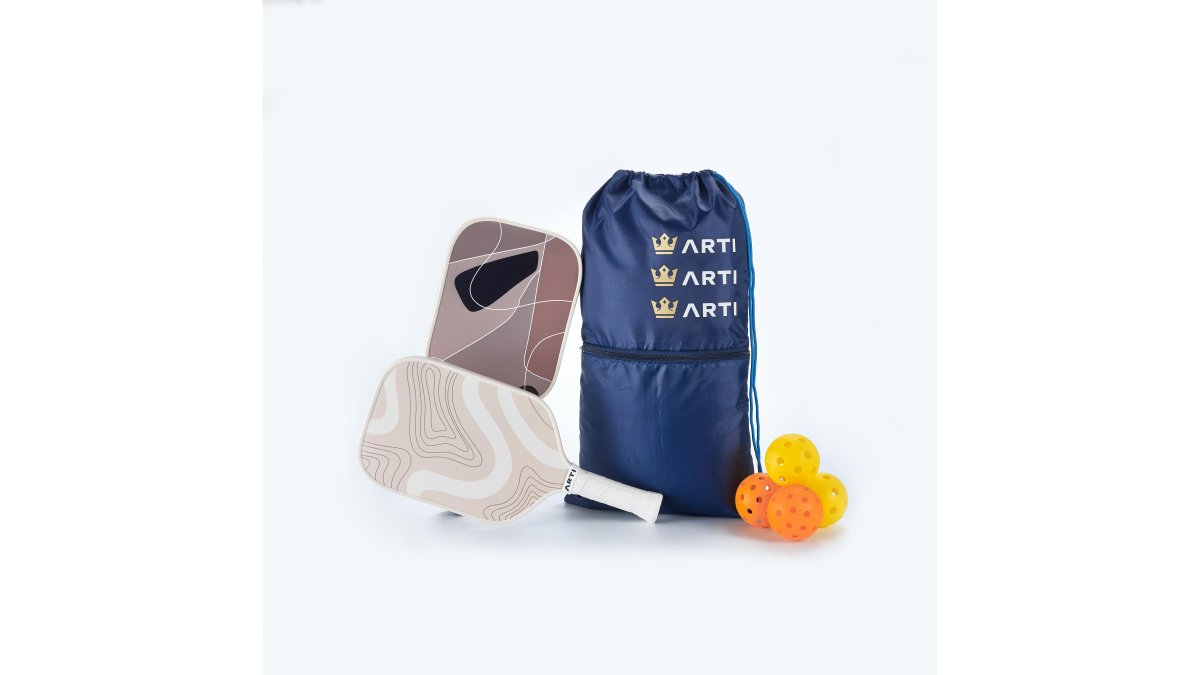
A set like the ARTI Fiberglass "Sandstorm" Pickleball Paddle Set ($79.99) covers the essentials in one order: two USA Pickleball Approved paddles, four outdoor balls, and a carry bag. The fiberglass face gives a larger sweet spot than carbon, which matters more than raw power while you're learning clean contact.

Pickleball Paddle Core Thickness Explained: 14mm vs 16mm
Core thickness is the single spec that shapes how a paddle feels. The core is the honeycomb layer between the paddle's two faces, and its thickness changes dwell time, how long the ball stays on the face.
A 16mm core is thicker, so the ball sinks in deeper and stays on the face longer. That longer contact absorbs more energy (softer feel), spreads impact across a wider area (larger sweet spot), and gives your hand more time to influence the shot (more control on dinks, drops, and resets).
Here is the trade-off in plain terms:
| Core Thickness | Feel | Sweet Spot | Best For | Trade-Off |
|---|---|---|---|---|
| 16mm | Soft, muted | Larger, more forgiving | Beginners, control players, dinkers | Less free power on drives |
| 14mm | Firm, poppy | Smaller, less forgiving | Advanced players, power hitters | Mishits punish you |
| 13mm and under | Very stiff | Smallest | Specialty power frames | Hardest to control |
How Core Thickness Interacts With Face Material
Core and face work as a pair, and beginners often buy one without thinking about the other. A fiberglass face is softer and flexes more, pairing naturally with a 16mm core for maximum forgiveness. A carbon fiber face is stiffer and generates more spin, and pairs with either core thickness, but on a 14mm core, it gets demanding fast.
Sweet Spot Size and Why It Matters More Than Power
Sweet spot size describes the area of the paddle face that still produces a predictable shot when you don't hit dead center. Beginners hit off-center constantly, so a bigger sweet spot means fewer balls into the net or sailing long.
| Spec | What It Affects | Beginner Priority |
|---|---|---|
| Core thickness (14mm vs 16mm) | Control vs pop, sweet spot size | 16mm for control |
| Face material (fiberglass vs carbon) | Sweet spot size, spin | Fiberglass for forgiveness |
| Weight (7.8-8.5 oz) | Maneuverability, fatigue | Midweight range |
| Grip circumference (4.0-4.25 in) | Wrist control, comfort | Measure your hand first |
Pickleball Ball Types for Indoor vs Outdoor Play
Indoor and outdoor balls are not interchangeable. Outdoor balls have 40 holes and a harder, denser plastic shell built to resist wind and hold a true bounce on textured surfaces. Indoor balls use 26 larger holes and a softer shell that stays playable on smooth gym floors, where a harder ball would skid.
Pickleball Court Shoes vs Running Shoes: What Your Feet Need
Court shoes beat running shoes for pickleball because the sport demands lateral movement, not forward stride. Running shoes are built with heel cushioning for straight-line running, making them unstable when you shuffle sideways along the non-volley zone line. Court shoes use a flatter, wider base with grippy outsoles for hard-stop traction and side-to-side stability.
Grip Size, Paddle Weight, and Handle Length
Grip size, weight, and handle length work together to determine how much control you have over the paddle, and beginners should prioritize control over power in all three. Get the grip wrong and you'll fight your own hand all match; get the weight wrong and your arm will tire by the third game.
Finding Your Grip Size
Grip circumference is measured in inches, and most players fit between 4.0 and 4.25 inches. Size matters because it changes how tightly you squeeze. Too small forces your fingers to wrap all the way around, encouraging a tense grip that tightens your forearm and reduces wrist snap. Too large feels like it's sliding, so you grip harder, same problem, different cause.
Paddle Weight Bands
Paddle weight falls into three bands, and each one changes how the paddle behaves over a full session:
- Lightweight (under 7.8 oz): Fastest hands at the net, easiest to maneuver in quick exchanges, but less plow-through on blocks and drives. Good for players with arm or shoulder fatigue.
- Midweight (7.8-8.5 oz): The balanced all-around choice. Enough mass to stabilize off-center hits without slowing your reaction time. This is the band most beginners should start in.
- Heavyweight (8.5 oz and up): Maximum power and stability on drives and blocks, but slower to move and more tiring over a long session. Better suited to players who already have consistent mechanics.
Handle Length and Playing Style
Handle length matters most if you want a two-handed backhand or play doubles where reach and quick hand changes decide points. A longer handle (5.5 inches and up) gives room to slide your lower hand down for two-handed shots and choke up for quick net exchanges. A shorter handle keeps the paddle face closer to your hand, which some find more stable on volleys.
Matching Gear to Your Playing Style
Before you buy, spend one session noticing how you actually play. If you dink and reset more than drive, lean toward a 16mm core, midweight frame, and a grip at the upper end of your measured range for stability. If you naturally attack and drive, a 14mm core and slightly lighter frame will reward that style, but only once your contact point is consistent.
Injury Prevention Gear and Court Surface Compatibility
Two things most beginner guides skip: protecting your body and matching gear to the court you actually play on. Pickleball injuries cluster around the shoulder, elbow, and Achilles, largely from repetitive motion and sudden lateral stops. A few inexpensive additions reduce that risk.
- Vibration dampening: A dampening grip or overgrip reduces shock traveling up your arm on off-center hits, which helps if you're prone to elbow soreness.
- Compression sleeves or braces: Useful if you have a history of elbow or knee issues, but not a substitute for warming up.
- Proper court shoes with cushioning: The single best injury-prevention purchase you can make.
- Eye protection: Recommended in doubles play, where balls fly fast at close range.
Rental, Used, or New: A Beginner Buying Decision Matrix
The cheapest path into pickleball isn't always buying new, but it depends on how committed you are. Rentals and demos let you test paddle weight and grip before committing. Used gear saves money but carries hidden costs: worn grips, dead cores, no warranty. New gear costs more upfront but comes with return windows and coverage.
| Option | Upfront Cost | Best For | Watch Out For |
|---|---|---|---|
| Rental / demo | Lowest | Testing before you commit | Limited paddle selection |
| Used paddle | Low | Casual players, tight budgets | Worn grips, no warranty |
| New starter set | Moderate | Most beginners | Overbuying features you can't use yet |
| New premium paddle | Highest | Committed players | Diminishing returns early on |
Frequently Asked Questions
What is the best pickleball equipment for beginners?
Start with a paddle that has a 16mm honeycomb core and a fiberglass face, which gives you a larger sweet spot and more forgiveness while you learn. Add four outdoor balls, a pair of court shoes with lateral support, and a bag to carry it all. A set like the ARTI Fiberglass Sandstorm comes with two USA Pickleball Approved paddles, four balls, and a carry bag for $79.99, so you can start playing without piecing gear together.
Do I want a 14mm or 16mm pickleball paddle?
For beginner pickleball gear, a 16mm core is the safer pick. The thicker core absorbs more vibration and produces a more even response, which helps with dinking, drops, and resets. A 14mm paddle feels crisper and delivers more raw power, but it demands cleaner contact. The Grasp 16mm paddle uses a honeycomb core and an elongated 16.45 x 7.5 inch shape to add reach and stability for two-handed shots.
How much should a beginner spend on their first pickleball paddle?
You can get a capable entry-level paddle for under $80. The FLiK Zip is $55 and pairs a 10mm polypropylene honeycomb core with carbon and fiberglass layers for spin and pop. The ARTI Sandstorm set is $79.99 and includes two paddles, four balls, and a bag, which works well if you are buying for a partner too. Spend more only once you know your playing style and preferred weight.
Do I need court shoes, or can I wear running shoes?
Running shoes are built for forward motion, not the lateral movement pickleball requires. Court shoes have flatter soles, grippier traction, and cushioning that holds up through repeated side-to-side steps and stops near the non-volley zone. Wearing running shoes raises your risk of rolling an ankle during a quick change of direction. Pick a court shoe with a reinforced toe and good tread for the surface you play on most.